
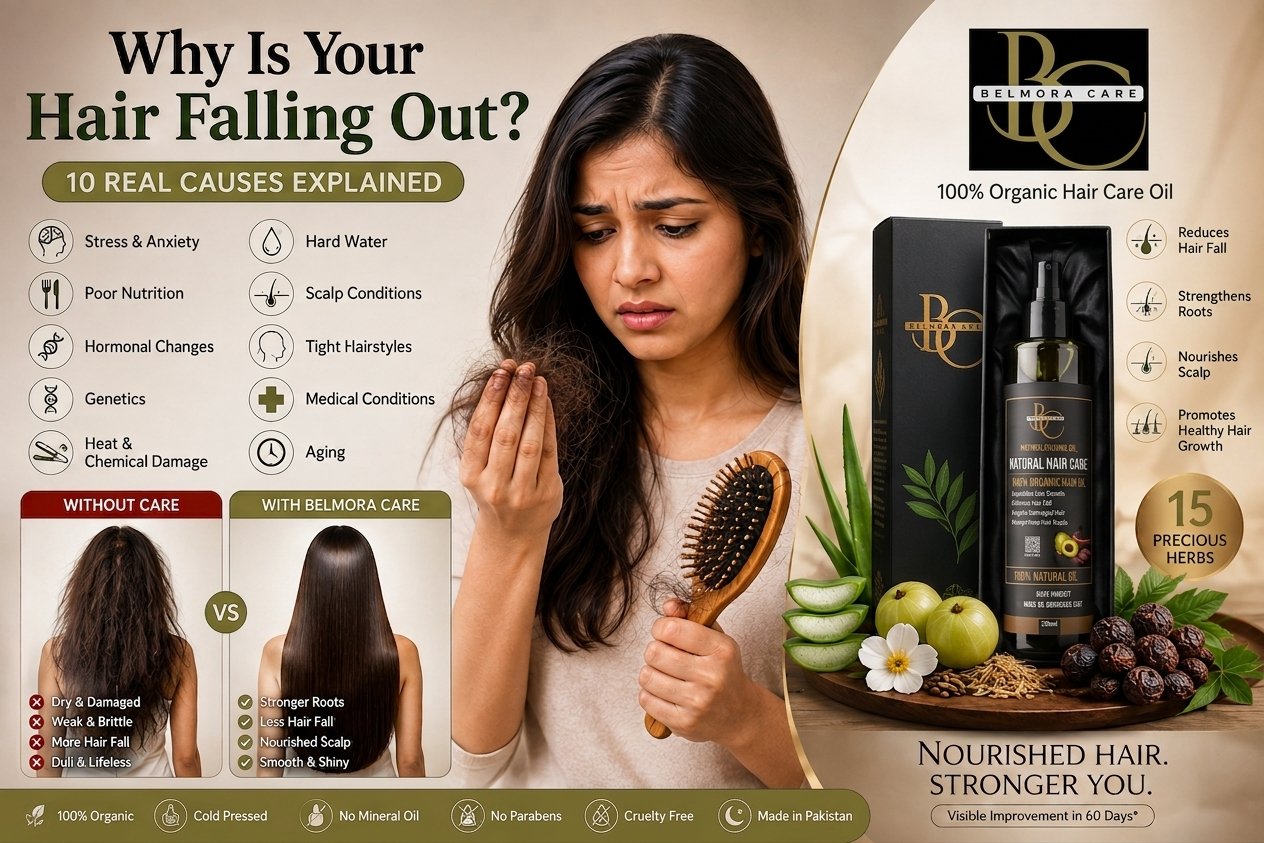
Why Is Your Hair Falling Out? 10 Real Causes Explained
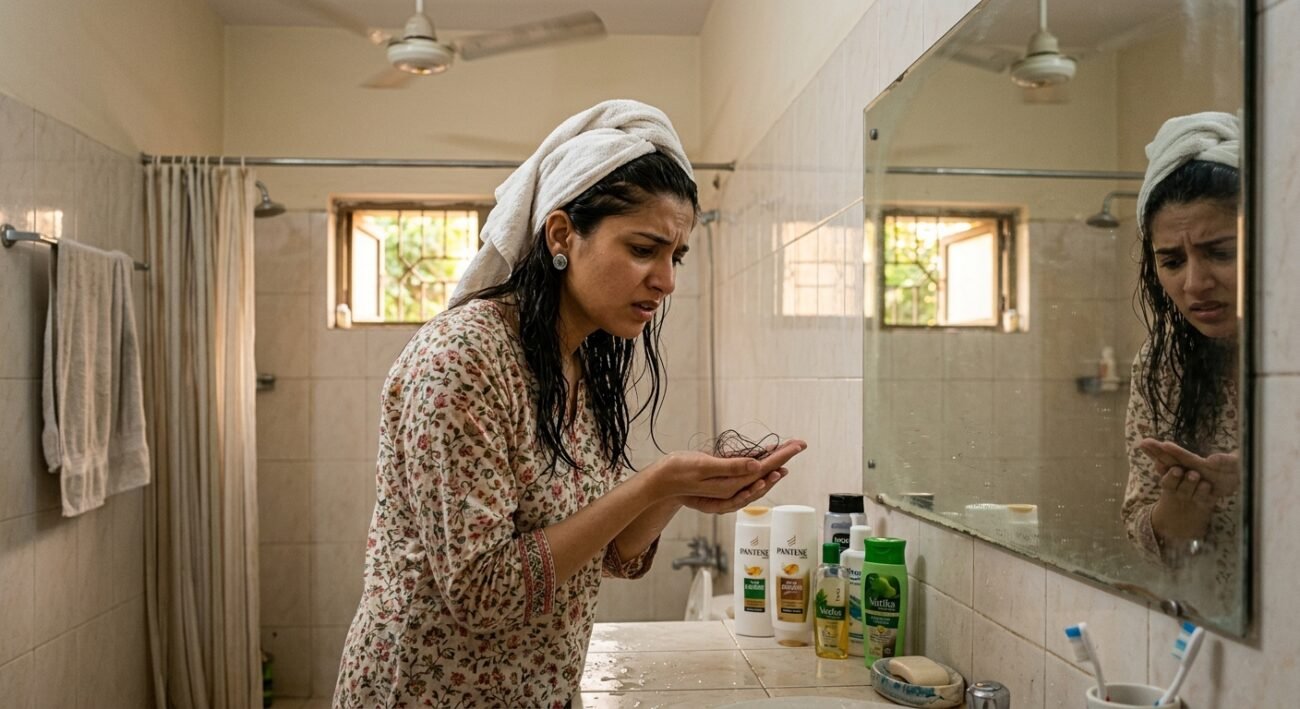
Ayesha had never counted the hairs in her brush before.
Then, after a few weeks of seeing more strands around the shower drain, she started paying attention. Her hair felt rougher after washing, became harder to detangle, and seemed to leave more strands on her towel.
Like many people in Pakistan, her first thought was simple:
“Maybe it’s the water.”
That may be part of the picture. But hair fall is rarely that simple.
Stress, genetics, hormones, nutrition, illness, scalp conditions and hair-care habits can all affect shedding. Environmental factors such as hard water can also contribute to hair-shaft weakening and breakage, which can look like increased hair fall.
So before blaming your shampoo, oil or water, it helps to understand what is actually happening.
Is Hair Shedding Always a Sign of Hair Loss?
No. Some daily hair shedding is normal because old hairs naturally leave the growth cycle. Excessive shedding, however, may indicate a temporary condition such as telogen effluvium or another form of hair loss. Hair breakage is different because the shaft breaks rather than the complete hair being shed from its follicle.
Normal Hair Shedding
Your hair is constantly cycling through different phases.
During the anagen phase, hair actively grows.
The catagen phase is a short transition period.
During the telogen phase, the hair rests before eventually shedding.
The AAD states that losing around 50 to 100 hairs a day can be normal.
That means seeing hair in your shower does not automatically mean you are becoming bald.
The more useful question is:
Has your normal pattern changed?
Look for signs such as:
- Noticeably increased shedding
- A widening part
- Receding hairline
- Visible thinning
- Bald patches
- Many broken short hairs
- Changes in scalp condition
Hair Shedding vs Hair Breakage
This is particularly important in the Pakistani hair-care context.
Shedding happens at the follicle.
Breakage happens along the hair shaft.
A person can have healthy follicles but still experience considerable breakage if the hair has been weakened by heat, chemicals, friction or environmental exposure.
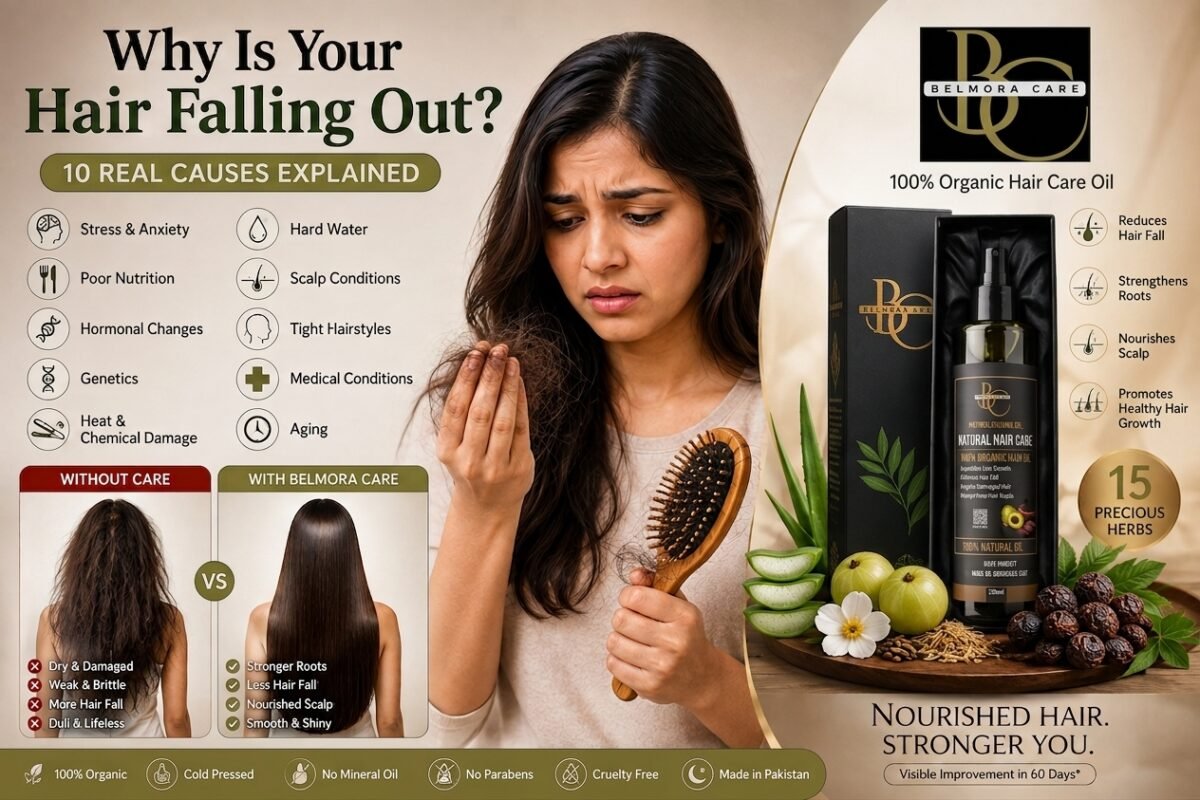
10 Real Causes of Excessive Hair Fall
1. Stress and Telogen Effluvium
A stressful event can affect your hair months after it happened.
This is one reason people sometimes think their hair loss has appeared “out of nowhere.”
Telogen effluvium is a form of excessive shedding that can follow physical or emotional stress.
Potential triggers include:
- Major emotional stress
- Fever
- Significant illness
- Surgery
- Childbirth
- Rapid weight loss
- Major dietary changes
Medical sources describe this delayed relationship between a trigger and subsequent shedding.
What can you do?
Think about what changed in your life a few months before the shedding started.
If the shedding is persistent or severe, a dermatologist can help determine whether telogen effluvium or another condition is involved.
2. Nutrition and Nutrient Deficiencies
Hair production depends on the body’s overall nutritional status.
Inadequate intake of nutrients such as iron, zinc and protein can be associated with hair problems. Other nutrients may also be relevant depending on the individual.
But there is an important warning:
Don’t automatically start taking multiple hair supplements.
A supplement is useful when it addresses a genuine need. Taking excessive amounts of certain nutrients can also cause problems.
A better foundation is:
- Eat a varied diet.
- Include adequate protein.
- Include nutrient-rich foods.
- Discuss suspected deficiencies with a healthcare professional.
- Avoid extreme dieting.
Healthy hair starts with more than what you put on your scalp.
3. Genetics and Pattern Hair Loss
Sometimes your family history provides the strongest clue.
Androgenetic alopecia, commonly called pattern hair loss, is a major cause of gradual thinning.
Genetically susceptible follicles can become progressively smaller, producing finer hairs over time.
Men commonly notice:
- Receding temples
- Crown thinning
- Progressive reduction in density
Women may notice:
- A widening central part
- Diffuse thinning
- Reduced density around the top of the scalp
This is why it is important not to assume that every case of hair thinning can be solved with oiling.
If thinning is progressive, professional assessment can help identify the cause and appropriate treatment. The AAD emphasizes that knowing the cause is central to managing hair loss.
4. Hard Water and Hair-Shaft Breakage
Now we come to a problem particularly relevant to many Pakistani households.
Hard water contains higher concentrations of minerals, especially calcium and magnesium.
But let’s make one distinction very clear:
Hard water should not automatically be called a cause of follicle-level hair loss.
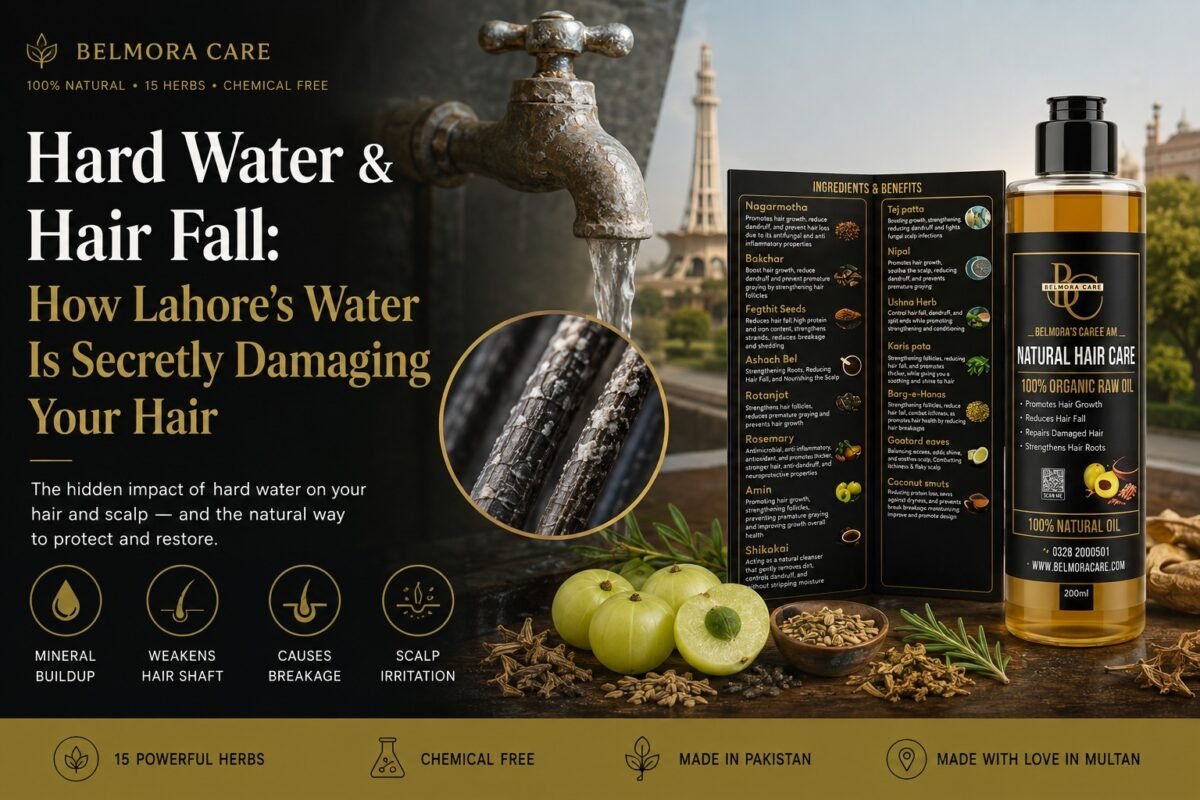
Research conducted in Pakistan examined hair exposed to hard water and found significantly reduced tensile strength compared with hair exposed to deionized water. The researchers concluded that hard water can weaken hair and increase breakage.
That is different from proving that hard water causes hereditary baldness.
What Does This Mean for You?
If your hair becomes:
- Rough after washing
- Difficult to detangle
- More prone to snapping
- Dry-looking
- More fragile during brushing
then water quality may be one factor worth investigating.
Calcium, Magnesium and Hair Strength
Hardness is largely associated with dissolved calcium and magnesium.
These minerals can interact with the hair surface and, according to the Pakistan-based experimental studies, prolonged exposure can reduce hair tensile strength.
This is a particularly valuable reference for a Pakistan-focused article because the research itself used water samples from districts in Khyber Pakhtunkhwa.
TDS Is Not the Same as Hardness
You may have heard someone say:
“Our water has high TDS, so that’s why my hair is falling.”
There is a little more chemistry involved.
TDS, or total dissolved solids, represents the broader amount of dissolved material in water.
Water hardness, meanwhile, is primarily associated with calcium and magnesium.
So:
High TDS does not automatically mean high hardness.
If you are genuinely concerned about your household water, testing the water is more useful than guessing from hair symptoms alone.
5. Heat, Humidity and Environmental Stress
Pakistan’s climate changes significantly by region and season.
A person living in Multan may experience intense summer heat, while someone in Islamabad may deal with different combinations of humidity, seasonal dryness and water conditions.
Humidity does not automatically cause hair loss.
But it can change the way hair behaves.
Hair that is already damaged may become more difficult to manage in humid conditions, leading to:
- Frizz
- Tangling
- Increased manipulation
- More mechanical stress
Meanwhile, excessive heat from styling tools can weaken the hair shaft.
The practical lesson is simple:
Don’t fight climate with more and more products. Build a protective routine.
6. Hormonal Changes
Hormonal changes can influence hair growth and shedding.
Examples include changes associated with:
- Thyroid disorders
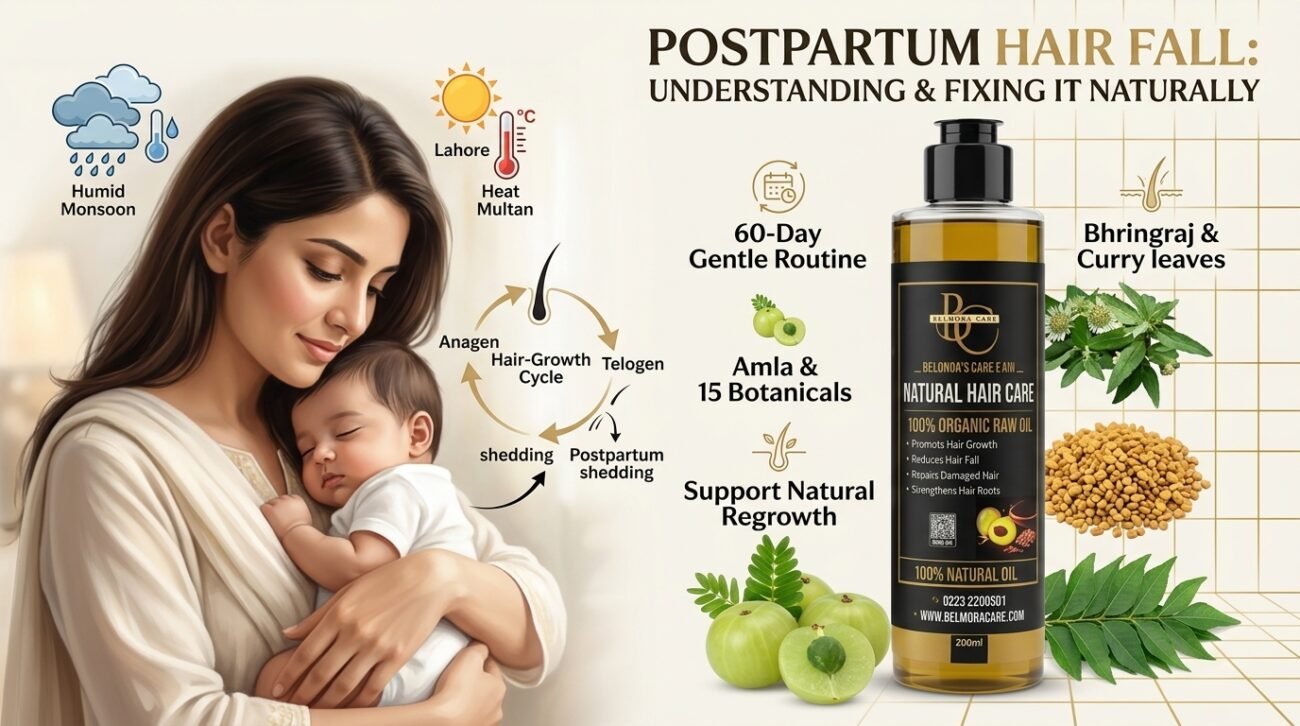
- Pregnancy and postpartum changes
- Menopause
- Certain hormonal conditions
Hormonal causes can look very different from simple hair breakage.
If hair loss appears alongside other unexplained changes in your health, speak with a qualified healthcare professional rather than assuming the problem is purely cosmetic.
7. Chemical Treatments and Heat Styling
Your hair can look beautiful while becoming progressively weaker.
Frequent:
- Bleaching
- Chemical straightening
- Relaxing
- Permanent coloring
- High-temperature straightening
- Aggressive blow-drying
can contribute to damage and breakage.
The AAD lists damaging hair-care practices and chemical treatments among possible contributors to hair problems.
A simple change
If you regularly use heat or chemical treatments, consider reducing frequency and lowering unnecessary heat exposure.
The goal is not perfection.
It is reducing repeated damage.
8. Tight Hairstyles and Mechanical Stress
A hairstyle should not regularly cause pain or strong pulling.
Repeated tension from tight ponytails, buns, braids or extensions can contribute to traction alopecia.
This is a different mechanism from hereditary hair loss.
The AAD and Cleveland Clinic both identify tight hairstyles as a potential cause of hair loss.
Try this
Give your hair periods of lower tension.
Also be gentle when:
- Detangling wet hair
- Removing hair ties
- Brushing knots
- Drying your hair
Sometimes the most useful hair-care product is simply less pulling.
9. Illness, Fever and Physical Stress
Think back several months.
Were you seriously ill?
Did you have a high fever?
Did you undergo surgery?
Did you experience another major physical stress?
Hair growth responds to changes throughout the body, and increased shedding can occur after significant physical stress.
This is another reason not to judge your hair only by what happened yesterday.
Today’s shedding can sometimes reflect yesterday’s health event.
10. Scalp Conditions
Your scalp is not just the surface underneath your hair.
It is the environment surrounding your follicles.
Persistent scalp problems can be associated with hair loss.
Pay attention to:
- Persistent itching
- Redness
- Pain
- Heavy scaling
- Crusting
- Patchy hair loss
- Sudden changes in scalp condition
Some scalp conditions require specific treatment, so don’t assume every itchy or flaky scalp simply needs more oil.
Why Pakistani Hair Can Feel Worse After Washing
Imagine two people with the same hair type.
One washes with relatively soft water.
The other regularly washes with harder water.
Their experience may not be identical.
Research from Pakistan found that hard-water exposure reduced the tensile strength of hair samples and increased the potential for breakage.
That doesn’t mean:
Hard water = baldness.
A more accurate relationship is:
Hard water → potential weakening of the hair shaft → greater vulnerability to breakage.
When that happens alongside heat, chemical treatments, friction or dryness, the overall appearance of hair fall may become more noticeable.
What Can You Actually Do About Excessive Hair Fall?
The best solution depends on the cause.
But there are several low-risk habits that can improve your overall hair-care routine.
Improve Your Washing Routine
Avoid treating your hair aggressively during washing.
Try:
- Lukewarm rather than extremely hot water
- Gentle scalp cleansing
- Thorough rinsing
- Conditioner on the lengths when appropriate
- Gentle towel drying
- Careful detangling
If your water is hard, consider investigating the water quality rather than simply changing shampoos repeatedly
.
Reduce Heat and Friction
Your hair shaft is more vulnerable when it is already dry or damaged.
Reduce:
- High-temperature styling
- Aggressive towel rubbing
- Excessive brushing
- Tight hairstyles
- Repeated chemical processing
Think of your hair as a fiber that needs to be handled carefully.
Support Hair From the Inside
A healthy hair routine also includes:
- Adequate protein
- Balanced nutrition
- Sufficient hydration
- Regular sleep
- Stress management
If you suspect a nutrient deficiency or medical condition, get appropriate professional advice rather than guessing.
Know When to Get Professional Help
Seek medical advice if you notice:
- Sudden severe shedding
- Bald patches
- Rapid thinning
- Persistent scalp inflammation
- Hair loss with other unexplained symptoms
- Progressive recession or crown thinning
The AAD recommends identifying the cause because treatment and prevention depend heavily on what is actually causing the hair loss.
Where Does Hair Oiling Fit?
Hair oiling has a long place in South Asian personal-care traditions.
But it is important to understand what oiling can and cannot reasonably do.
A hair oil can be used as part of a routine focused on:
- Conditioning
- Hair manageability
- Scalp massage
- Reducing dryness
- Supporting a consistent grooming routine
It should not be presented as a universal treatment for genetic hair loss, autoimmune alopecia, thyroid-related shedding or other medical conditions.
A Simple Oiling Routine
If oiling suits your hair and scalp:
- Apply an appropriate amount of oil according to the product directions.
- Massage gently rather than scratching the scalp.
- Allow the oil to remain according to the product instructions.
- Wash gently.
- Avoid aggressive towel rubbing afterward.
- Observe how your scalp and hair respond.
The goal is consistency, not using excessive amounts of oil.
Where Belmora Care Fits Into the Routine
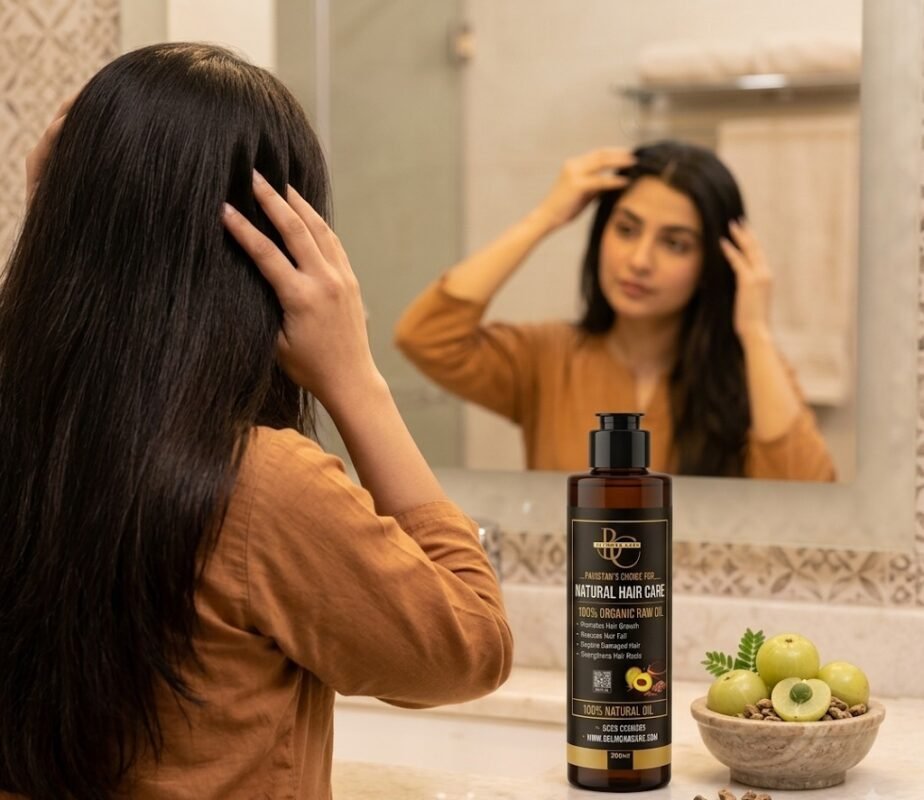
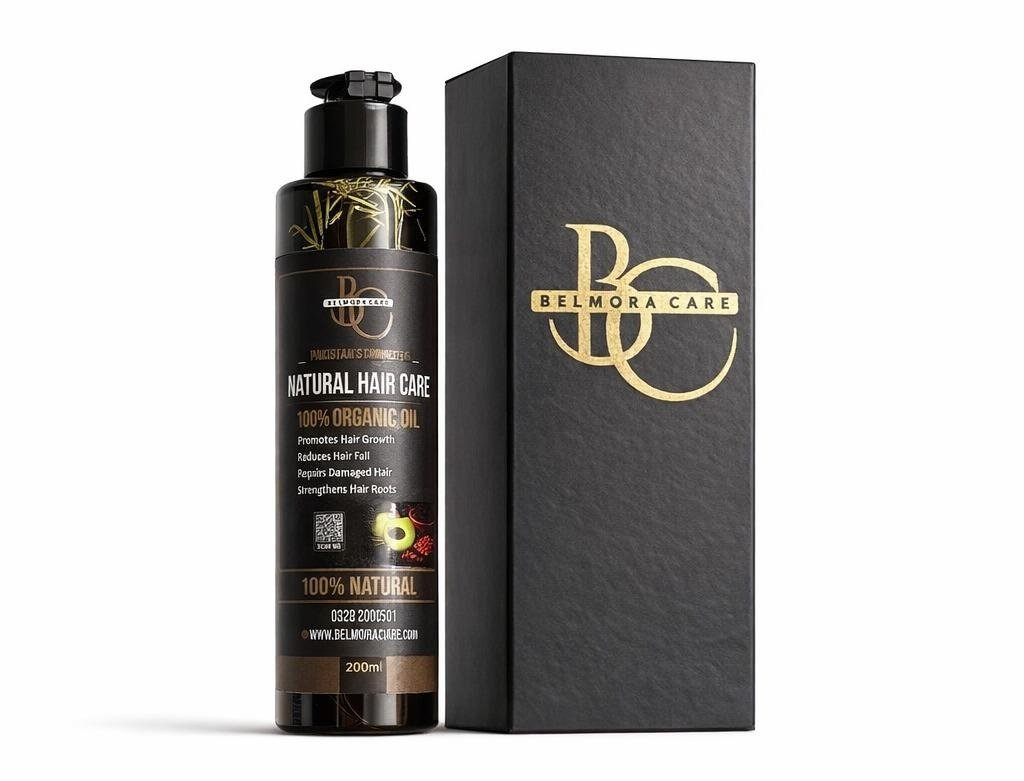
Belmora Care is a Pakistan-based herbal hair-care brand from Multan, Punjab. Its current product page describes the Belmora Care 100% Organic Hair Care Oil as a botanical hair oil intended for routine care around concerns including hair fall, dryness, breakage and dull hair.
[Internal Link: “Belmora Care 100% Organic Hair Care Oil” → Target Context: Product page.]
The current product page describes the formula as a blend of time-tested herbs and botanical oils and positions it as suitable for both men and women.
For the Belmora formulation, the brand’s provided ingredient information includes traditional botanicals such as:
- Amla
- Bhringraj
- Aloe Vera
- Balchar
- Shikakai
- Mustard Seed
- Nagarmotha
These ingredients are best presented as part of the product’s traditional botanical formulation, rather than assigning each herb a medically proven hair-regrowth function.
Why This Matters
If your concern is primarily dry, rough or breakage-prone hair, an oil can fit naturally into a broader routine.
If your concern is sudden or progressive follicle-level hair loss, the first priority is understanding the cause.
That distinction protects the reader and makes the brand more trustworthy.
A Practical Weekly Hair-Care Routine
Here is a simple routine someone can adapt to their own hair type.
Wash Days
- Clean the scalp gently.
- Avoid very hot water.
- Condition the lengths if appropriate.
- Detangle carefully.
- Reduce heat styling afterward.
Oiling Day
Use your preferred botanical hair oil according to its directions.
Focus on gentle application and scalp massage rather than vigorous rubbing.
Throughout the Week
- Avoid unnecessarily tight hairstyles.
- Limit excessive heat.
- Protect hair from repeated friction.
- Pay attention to scalp changes.
- Maintain balanced nutrition.
- Consider your household water quality.
[Insert Image: Pakistani home hair-care routine showing gentle oiling, washing and detangling steps.]
Common Mistakes People Make When Their Hair Starts Falling
Mistake 1: Blaming One Product
Hair loss can have multiple causes.
Changing shampoo every few days makes it difficult to understand what is actually happening.
Mistake 2: Assuming Every Hair in the Shower Is Hair Loss
Some shedding is normal.
Breakage can also occur during washing and detangling.
Mistake 3: Blaming Hard Water for Everything
Hard water has evidence linking it with hair-shaft weakening and breakage, including research from Pakistan. But that does not establish it as the cause of every type of hair loss.
Mistake 4: Expecting Oil to Treat Every Medical Condition
A botanical oil can be part of hair care.
It should not replace medical assessment when there is unexplained or progressive hair loss.
Frequently Asked Questions
How much hair loss is normal per day?
Around 50 to 100 hairs a day is commonly considered normal shedding. However, counting hairs is not a reliable diagnostic test. A noticeable change in density, hairline or shedding pattern is more important.
Can stress cause hair loss?
Yes. Significant physical or emotional stress can disrupt the hair-growth cycle and cause increased shedding, sometimes appearing months after the stressful event.
Can hard water cause hair fall?
Hard or mineral-rich water can contribute to hair-management problems such as roughness and buildup, but it should not automatically be considered the cause of significant hair loss. Hair loss has many possible causes, so persistent shedding should be assessed more broadly.
Is hair oil better than conditioner?
They serve different purposes. Conditioner is primarily used during or after washing to improve manageability and reduce friction, while oiling can be an optional pre-wash or hair-care step. One does not automatically replace the other.
Can natural hair oil regrow lost hair?
A botanical oil should not be presented as a guaranteed hair-regrowth treatment. It can be part of a supportive hair-care routine, but genetic, hormonal, nutritional, inflammatory and medical causes may require specific professional treatment.
Does washing hair cause hair loss?
Washing normally does not mean that shampoo is causing permanent hair loss. You may simply notice hairs that were already ready to shed during washing. Rough handling, excessive heat and damaging hair-care practices can, however, increase breakage.
Should I stop oiling if my hair is falling?
Not necessarily. If you enjoy oiling and your scalp tolerates it, it can remain part of your routine. But if you experience irritation, worsening scalp symptoms or significant unexplained shedding, focus on identifying the underlying problem rather than relying solely on oil.
Can vitamins stop hair fall?
Only when a deficiency or nutritional problem is actually contributing to the shedding. Taking unnecessary high-dose supplements is not automatically beneficial and can sometimes be harmful.





 Free shipping to all over Pakistan
 100% Organic Herbs – No Chemicals