
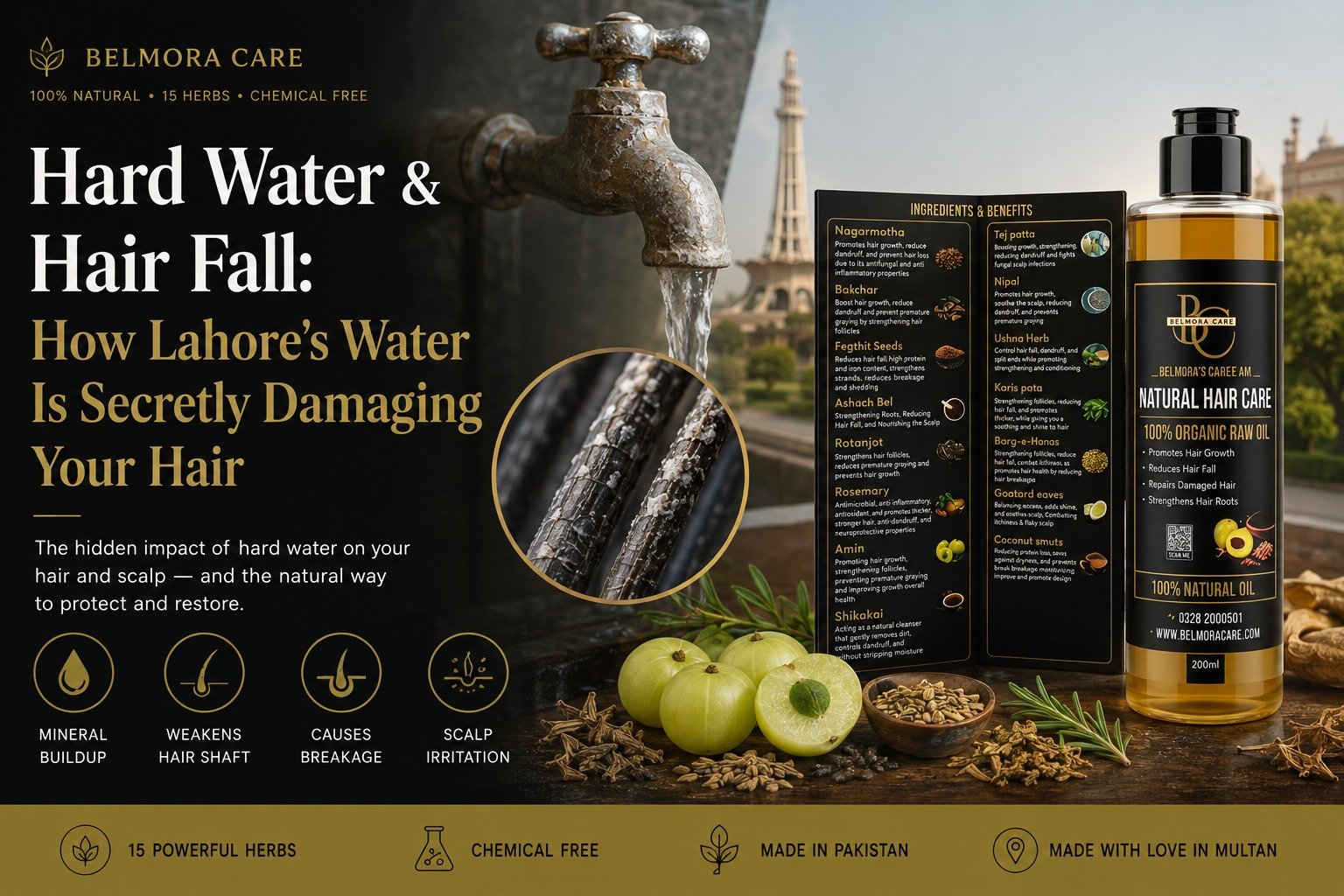
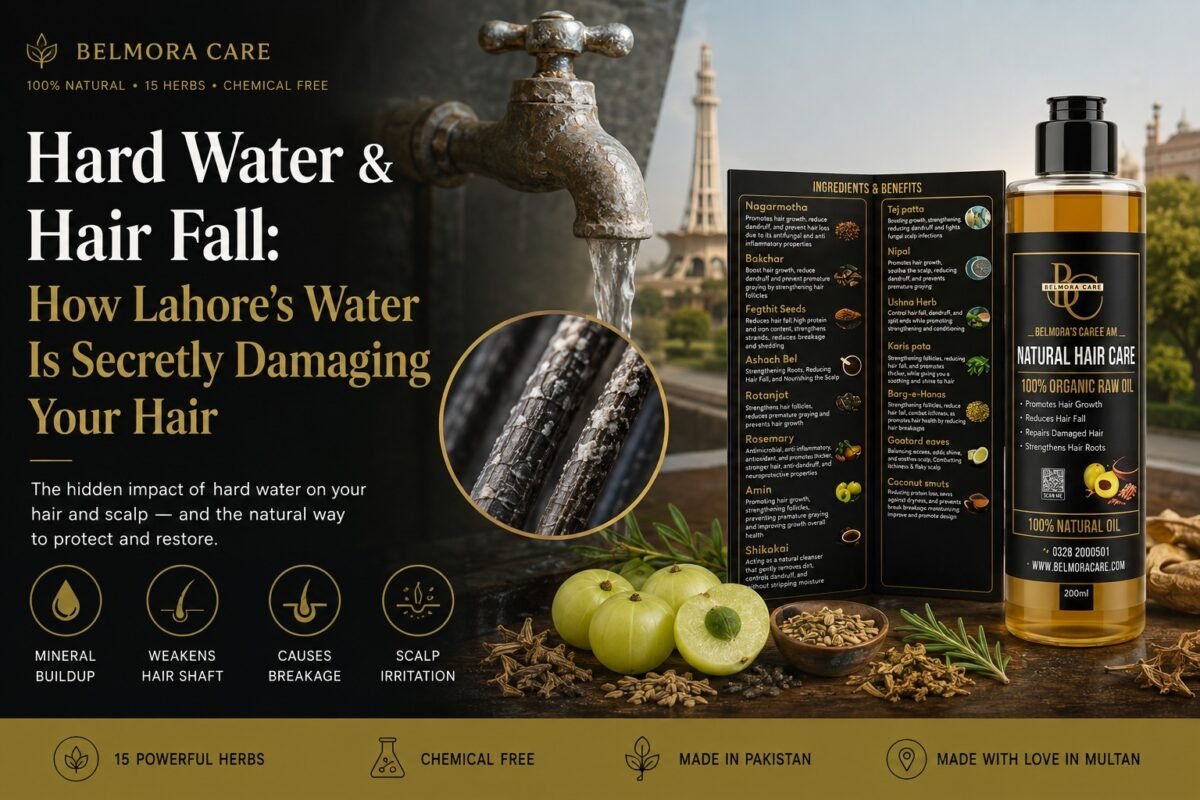
Hard Water & Hair Fall: How Lahore’s Water Is Secretly Damaging Your Hair
Why Lahore’s Water May Be Making Your Hair Feel Rougher
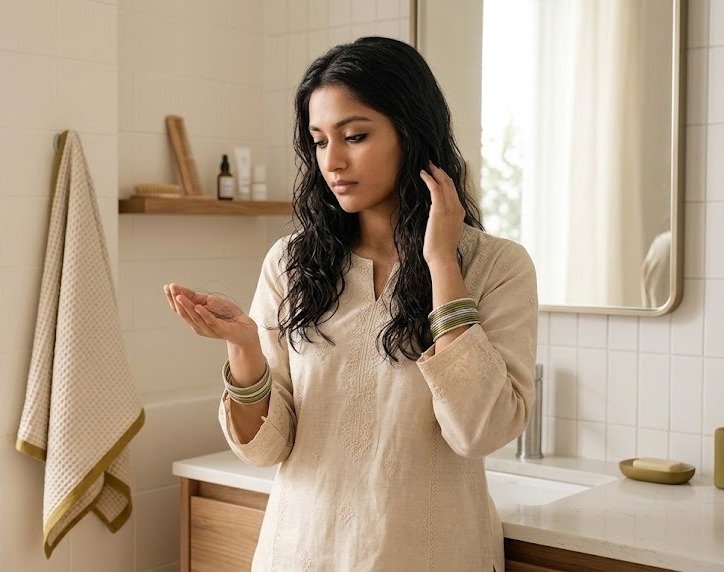
If you’ve ever noticed white crust around a Lahore bathroom tap, stubborn soap residue on tiles, or hair that suddenly feels rough after washing, the problem may not be your shampoo alone.
Hard water contains elevated concentrations of minerals, particularly calcium and magnesium. When these minerals repeatedly contact hair, some can deposit onto the hair fibre and alter its physical properties. Scientific studies have demonstrated mineral deposition and changes in hair strength after repeated exposure to hard water.
That makes hard water hair fall Lahore a useful search question—but there is an important distinction: hard water is better established as a contributor to hair shaft damage and breakage than as a direct cause of follicle-level hair loss.
What Is Hard Water, and Why Does It Matter for Hair?
Water hardness primarily comes from dissolved calcium and magnesium. The World Health Organization notes that harder water can produce scale and soap scum, particularly as hardness rises above approximately 200 mg/L under suitable chemical conditions.
The same basic chemistry that leaves scale on a tap can interact with your hair.
Hair is not simply a dead fibre with no chemistry. Its outer cuticle contains protein structures and charged sites capable of interacting with minerals. Research on human hair has found that calcium and magnesium can be taken up by the hair fibre during ordinary hygiene exposure, with hair condition and pH influencing this interaction.
This becomes especially relevant when hair is already:
- chemically treated
- bleached or coloured
- frequently heat-styled
- naturally dry or porous
- repeatedly exposed to hard water
- washed aggressively
Damaged or porous hair can provide more opportunities for mineral interaction.
Does Hard Water Actually Cause Hair Fall?
This is where many online hair-care claims become misleading.
If you see more strands in your shower drain after moving to an area with harder water, it does not automatically mean the water has killed your follicles.
There are two different processes:
- Hair shedding occurs when a hair naturally exits the follicle.
- Hair breakage occurs when the hair fibre snaps somewhere along its length.
Hard water has stronger evidence behind the second mechanism.
A Pakistani study published in the International Journal of Trichology compared hair exposed to hard water with hair treated using deionized water. The researchers found significantly reduced tensile strength in the hard-water-treated samples and concluded that hard water could increase breakage. Another study involving hard water from Khyber Pakhtunkhwa similarly found significantly lower tensile strength in hair exposed to hard water.
So when someone says, “Hard water is causing my hair fall,” the more scientifically cautious explanation is: Hard water may increase hair fibre damage and breakage, which can make overall hair loss appear worse. It should not automatically be blamed for every type of shedding.
Persistent sudden shedding, widening part lines, bald patches, scalp inflammation, or rapidly progressive thinning deserves evaluation for other causes.
How Calcium and Magnesium Interact With the Hair Shaft
Think about the difference between freshly washed fabric and fabric coated with mineral residue.
Hair can experience a similar physical effect.
Studies have detected calcium and magnesium deposition following hard-water exposure. One scanning-electron-microscopy study reported greater mineral deposition and reduced measured hair thickness in hard-water-treated samples. Another investigation found that magnesium deposition differed significantly between hard- and soft-water-treated hair, although the researchers cautioned that mineral deposition does not necessarily produce obvious structural changes under microscopy.
This distinction matters. Hard water is not a magical follicle-blocking substance. There is insufficient evidence to claim that calcium literally plugs every follicle and prevents new hair from growing.
Instead, repeated mineral exposure can influence the hair fibre environment, particularly when combined with existing damage.
The Hard-Water–Breakage Cycle
A typical cycle can look like this:
Hard water exposure → mineral interaction → rougher fibre → increased friction → tangling → mechanical stress → breakage
Now add common Pakistani hair-care habits. Frequent washing, vigorous towel drying, hot water, tight hairstyles, straightening, colouring and repeated brushing can compound mechanical stress.
In Lahore, seasonal changes can also alter how the scalp and hair feel. Hot weather, humidity, dust and frequent sweating may encourage more frequent washing, while dry winter air can make already fragile hair feel rougher.
The solution is therefore not simply “buy a hair-fall oil.”
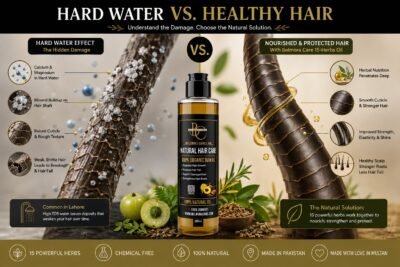
Hard Water Does Not Affect Every Person Equally
Two people can use the same water and experience very different results.
Why? Because hair condition matters. Research has shown that the hair’s condition—including its degree of oxidative damage—affects how strongly it interacts with water-hardness metals. Hair pH and the availability of charged sites on the fibre also influence mineral uptake.
Someone with virgin, healthy hair may tolerate the same water better than someone with repeatedly bleached, porous hair. This is why a personalized hair routine is more useful than blaming a single environmental factor.
How to Protect Your Hair From Lahore’s Hard Water
1. Avoid Very Hot Water
Hot water is not necessary for cleaning the scalp. Use comfortably lukewarm water instead.
Excessive heat can make already dry hair feel more stripped and uncomfortable.
2. Reduce Mechanical Stress
Don’t aggressively rub wet hair with a towel.
Wet hair is mechanically vulnerable. Gently squeeze excess water and use a soft towel or cotton fabric before detangling.
3. Consider a Shower or Water Filter
If your household water is demonstrably hard, filtration or an appropriate water-treatment system may reduce some mineral exposure.
The right solution depends on the actual composition of the household water, so testing is preferable to assuming that every Lahore water supply has the same hardness.
4. Use a Periodic Clarifying Strategy
If mineral buildup is suspected, an appropriate clarifying or chelating hair-care product can help remove deposits. However, over-cleansing can create another problem: excessive dryness and increased fibre friction. The goal is controlled removal, not stripping the hair repeatedly.
5. Support the Scalp and Hair Fibre
After reducing environmental exposure, focus on maintaining the scalp’s normal barrier and minimizing unnecessary friction. This is where botanical oils can have a supporting role—but they should not be presented as water-softening agents or guaranteed cures for hair loss.
Why Lipid-Compatible Botanical Hair Care Can Be Useful
A silicone-containing product may make damaged hair feel smoother because it can temporarily reduce friction and improve surface conditioning. That does not necessarily mean the underlying environmental stress has disappeared.
Likewise, highly drying products can produce a “clean” sensation while leaving some people with increased dryness or irritation. A lipid-rich botanical oil takes a different approach: it can provide conditioning and lubrication while helping reduce friction between hair fibres.
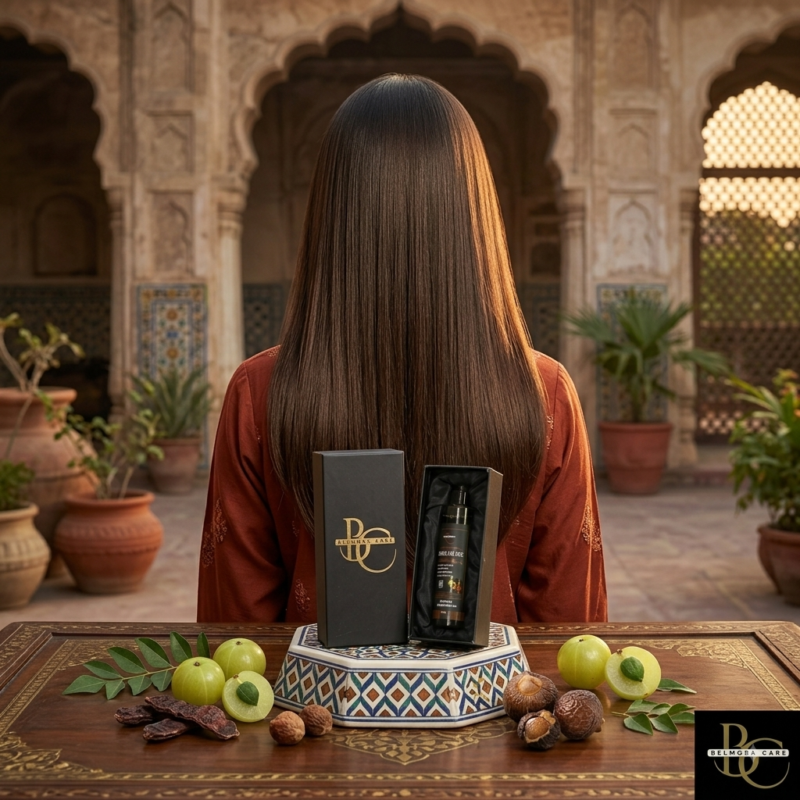
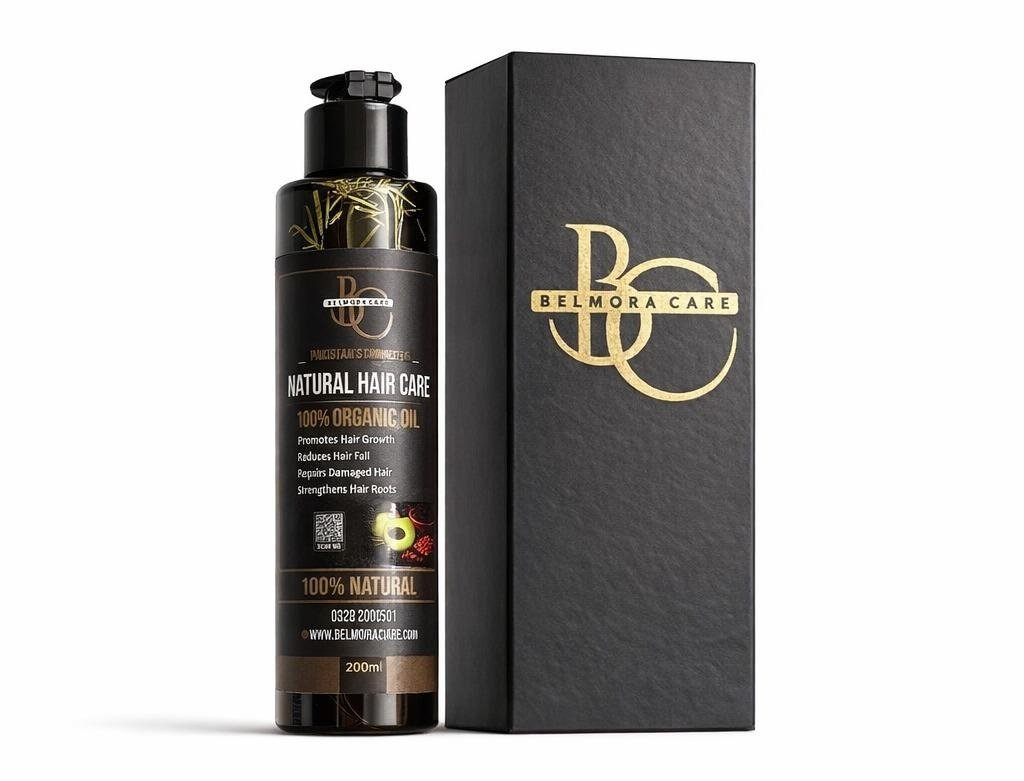
Belmora Care’s formulation combines 15 traditional botanicals, including Amla, Bhringraj, Aloe Vera, Rosemary, Fenugreek and Curry Leaf, in a cold-pressed herbal oil system. The purpose should be understood realistically: support scalp and hair conditioning rather than “unclogging dormant follicles” or reversing every form of hair loss.
Amla (Emblica officinalis) contains polyphenolic compounds including gallic- and ellagic-acid-related constituents, while rosemary and other botanicals contain diverse antioxidant compounds. These biochemical properties make them interesting ingredients for cosmetic scalp care, but laboratory antioxidant activity should not automatically be translated into a clinical claim that an oil prevents human hair loss.
This distinction is important for trustworthy hair-care communication.
Hard Water vs. Hair Oil: They Solve Different Problems
Hard water management and botanical oiling should not be treated as competing solutions. They address different parts of the problem.
| Problem | More Appropriate Strategy |
| Mineral exposure | Improve water quality or use suitable cleansing |
| Mineral residue | Periodic appropriate clarifying/chelating care |
| Dry, rough hair | Conditioning and reduced friction |
| Mechanical breakage | Gentle brushing, drying and styling |
| Scalp dryness | Appropriate scalp moisturization |
| Persistent shedding | Identify the underlying cause |
| Pattern thinning | Professional assessment and evidence-based treatment |
This is also why an oil cannot “cancel out” hard water.
If mineral exposure continues, the environmental source should still be addressed.
What About Scalp Calcification?
“Scalp calcification” is frequently used online to describe hard-water deposits around hair follicles.
However, it is important not to confuse cosmetic mineral residue on the hair surface with pathological calcification of scalp tissue. There is evidence that calcium and magnesium can interact with the hair fibre, but that does not establish that Lahore’s hard water causes pathological calcification around human follicles.
A scientifically responsible hair-care article should therefore avoid claiming that hard water literally calcifies follicles. If a person develops persistent scalp scaling, inflammation, severe itching, painful lesions or sudden hair loss, the issue may involve dermatological conditions unrelated to water hardness.
A Practical 60-Day Hard-Water Hair Routine
A realistic 60-day approach should focus on reducing damage rather than promising instant follicle regeneration.
Days 1–15: Reduce Environmental Stress
Identify whether your household water is actually hard. Reduce very hot water, aggressive towel drying and excessive brushing.
Days 16–30: Address Accumulation
If appropriate for your hair type, introduce periodic clarifying or chelating care. Avoid using strong cleansing treatments excessively.
Days 31–45: Improve Conditioning
Use a consistent conditioning routine and minimize heat styling. A lightweight botanical oil can be incorporated according to scalp and hair tolerance.
Days 46–60: Evaluate the Pattern
Compare breakage, hair texture, scalp comfort and visible shedding with your starting point.
A 60-day period can be useful for assessing changes in routine-related breakage and shedding, but it should not be presented as a guaranteed biological deadline for follicular regeneration.
When Hard Water Is Probably Not the Main Problem
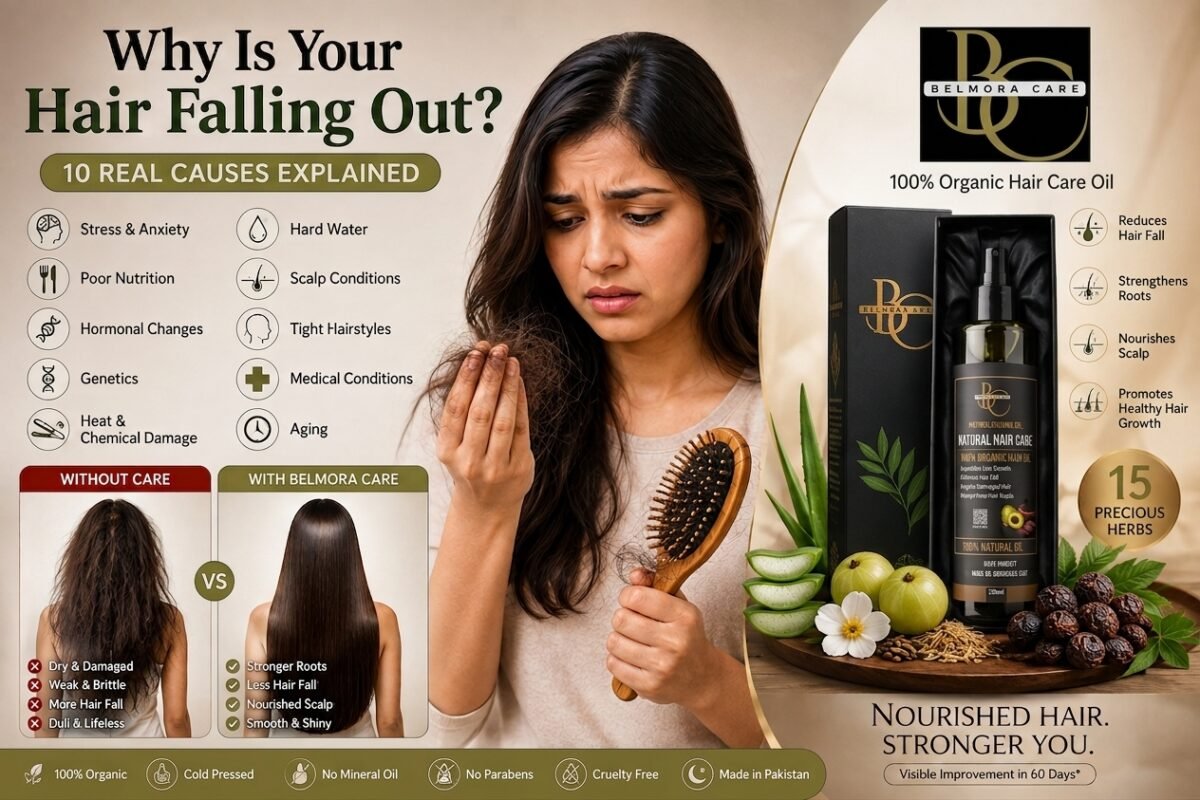
If your hair continues thinning despite improving water exposure, investigate other possibilities. Hair loss can involve genetics, hormonal factors, nutritional deficiencies, illness, medications, scalp disorders, stress-related shedding and other biological factors.
For example, androgenetic alopecia involves follicular sensitivity to androgen signaling and is not caused by calcium deposits from shower water. Therefore, treating hard water can be useful without assuming it explains everything. The best hair-care strategy is environmental protection plus identification of the actual cause of persistent hair loss.
Belmora Care’s Role in a Hard-Water Hair Routine
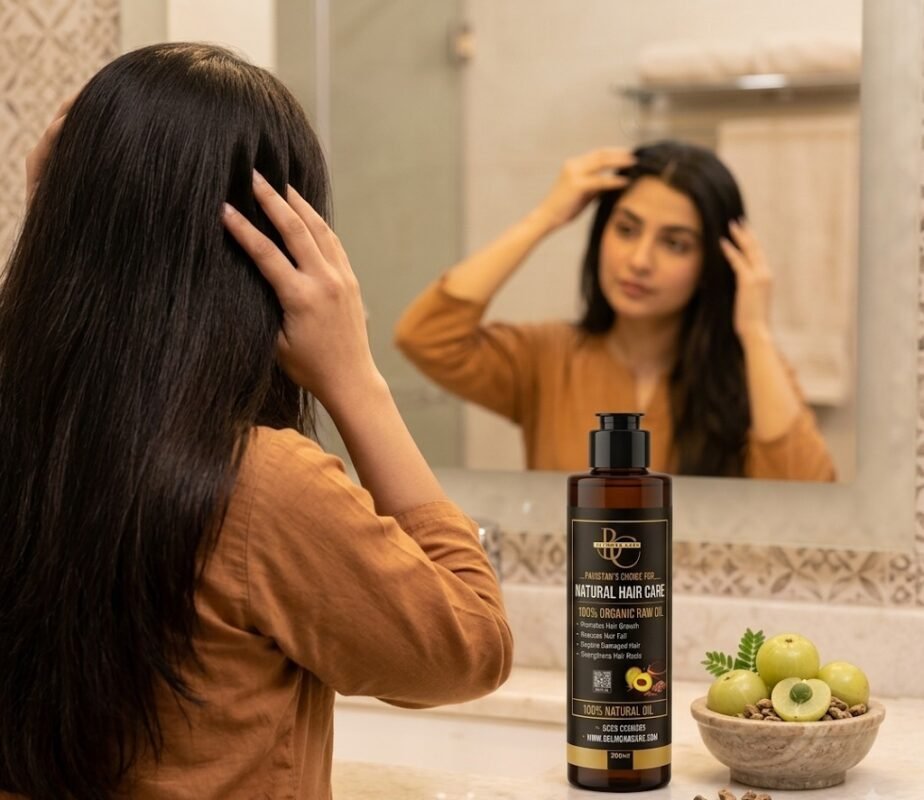
Belmora Care’s 100% herbal hair oil is designed around traditional botanical ingredients including Amla, Bhringraj, Aloe Vera, Rosemary, Fenugreek and Curry Leaf. Its role in a hard-water routine is supportive: conditioning the scalp and hair, improving lubrication and helping reduce the dry, rough feel that can accompany environmental and mechanical stress.
It should not be marketed as a water softener, medical treatment, or guaranteed cure for hair loss. For people in Lahore, Multan, Faisalabad, Rawalpindi and Islamabad, the practical combination is straightforward:
Test your water → reduce mineral exposure → cleanse appropriately → condition the hair → minimize mechanical damage → support the scalp consistently → investigate persistent shedding.
You can explore the Belmora Care herbal hair-care range when choosing a botanical conditioning option for your routine.
Conclusion
Hard water deserves attention when your hair suddenly feels rough, tangled, dry or unusually prone to breakage.
Scientific evidence supports the interaction between calcium and magnesium and the hair fibre, and Pakistani research has reported reduced tensile strength following hard-water exposure.
But hard water should not become the explanation for every case of hair loss.
The smarter approach is to manage the environmental trigger, reduce mechanical damage, maintain the scalp’s protective environment and use conditioning products consistently.
For a botanical conditioning step, Belmora Care’s 15-herb formulation is designed around traditional ingredients including Amla, Bhringraj, Aloe Vera, Rosemary, Fenugreek and Curry Leaf.
Start with the source: understand your water. Then protect the fibre. Then support the scalp.
For personalized product guidance, readers can contact Belmora Care through WhatsApp at 03282000501.
Frequently Asked Questions
1. Does hard water cause hair fall in Lahore?
Hard water is more strongly associated with hair-shaft mineral deposition, roughness and reduced tensile strength than direct follicle-level hair loss. If your hair appears to be “falling” because it is snapping during brushing or washing, hard-water-related breakage may be contributing.
2. How does Lahore hard water damage hair?
Calcium and magnesium in hard water can interact with the hair fibre and contribute to mineral deposition. Research has reported changes in hair strength and mineral accumulation after repeated exposure. The effect can be more noticeable in already damaged, porous or chemically treated hair.
3. Can hard water make hair thinner?
Hard water can contribute to breakage, making the visible density of the hair look reduced. However, this is different from follicular miniaturization. Persistent thinning should not automatically be attributed to water hardness and may require evaluation for genetic, hormonal or other causes.
4. Does calcium buildup block hair follicles?
There is not enough evidence to claim that ordinary hard-water exposure literally blocks human hair follicles with calcium deposits. Mineral deposition on the hair shaft is better documented. Claims that hard water causes widespread “follicle calcification” should therefore be treated cautiously.
5. How can I protect my hair from hard water?
Reduce very hot washing, minimize mechanical friction, consider appropriate filtration or water treatment, and use suitable cleansing and conditioning products. If mineral buildup is significant, periodic clarifying or chelating care may help. The exact routine should match your hair’s porosity and condition.
6. Is hair oil useful for hard-water damage?
A hair oil cannot remove hard-water minerals or soften water. Its potential role is conditioning and lubrication, which may help reduce friction and improve the feel of dry hair. Belmora Care’s 15-botanical formulation can be incorporated as supportive scalp and hair conditioning rather than as a hard-water cure.
7. Can Amla help hair exposed to hard water?
Amla contains several polyphenolic compounds with antioxidant activity, making it a useful traditional cosmetic ingredient. However, evidence that Amla specifically reverses hard-water-induced follicular damage in humans is limited. It should be viewed as part of supportive hair care rather than a clinically proven hard-water treatment.
8. How long does it take to improve hair affected by hard water?
Texture and breakage can improve after environmental and routine changes, but the timeline varies by hair condition. A 60-day routine provides a reasonable period for evaluating changes in breakage, scalp comfort and shedding patterns, but it should not be considered a guaranteed regrowth deadline.
9. Should I use a water filter for hard-water hair fall?
A suitable filtration or water-treatment system may reduce exposure to certain minerals, but the appropriate technology depends on the actual water chemistry. Testing household water hardness is preferable to purchasing a system based only on assumptions about Lahore’s water supply.
10. Can Belmora Care stop hard-water hair fall?
Belmora Care cannot remove minerals from household water and should not be presented as a guaranteed cure for hair loss. Its 15-botanical oil can be used as supportive scalp and hair conditioning within a broader routine that addresses water exposure, cleansing, friction and possible underlying causes.






 Free shipping to all over Pakistan
 100% Organic Herbs – No Chemicals
One thought on “Hard Water & Hair Fall: How Lahore’s Water Is Secretly Damaging Your Hair”